You don’t need to become an expert in peptide chemistry to shop this category safely. What you need is a checklist you run on every seller before you hand over your card. Do that, and you’ll sort the legitimate providers from the storefronts in about five minutes flat. Skip it, and you’re gambling with something you inject.
A heads-up before we get into it: most of what’s marketed as an “immune-support peptide” is not FDA-approved for that use in the US. Some of it is compounded medication, some of it is a research chemical with a legal disclaimer stapled to the label. Every claim below is tied to a source you can go check yourself. That habit, checking the source, is basically the whole point of this article.
What “immune-support peptides” actually means (hint: it’s not one thing)
First red flag to watch for: a seller that talks about “immune-support peptides” like it’s a single product line. It isn’t. Thymosin alpha-1, thymulin, LL-37, glutathione, and VIP get lumped under that label because each one touches immunity or inflammation somewhere in the body. That’s it. That’s the whole connection. Different mechanisms, different dose forms, wildly different amounts of evidence. If a site treats all five like flavors of the same “immune booster,” that’s your first clue you’re dealing with marketing copy, not a clinical catalog.
Check the evidence before you check the price
This is the step that saves you the most money, so let’s be specific about where each compound actually stands.
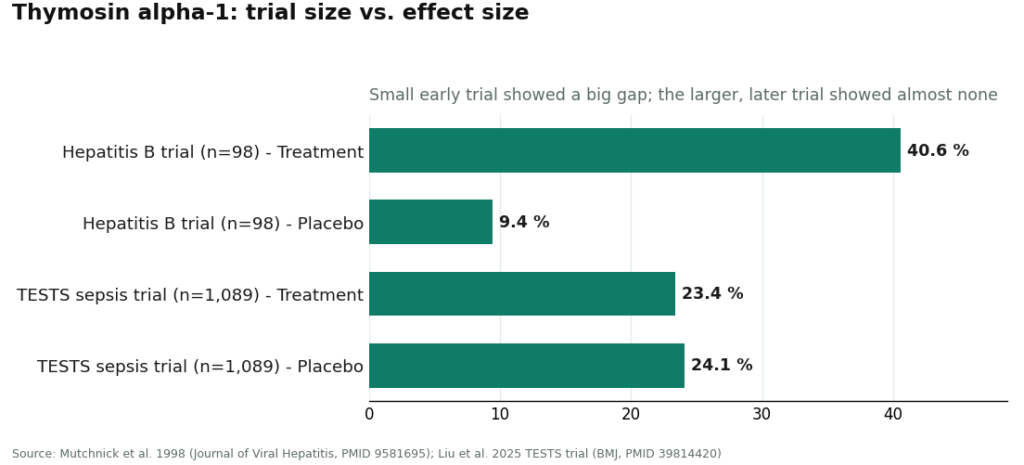
Thymosin alpha-1 is the one with real receipts. The synthetic version is an approved drug in more than 35 countries for hepatitis B and C, working through a genuine mechanism that helps normalize T-cell function [1]. A 1998 randomized controlled trial in 98 chronic hepatitis B patients found complete virological response in 40.6% of treated patients versus 9.4% on placebo [2]. But here’s the catch you deserve to know before you spend anything: the effect shrank as the trials got bigger and better designed. The large TESTS trial, 1,089 sepsis patients, found 28-day mortality of 23.4% with the peptide versus 24.1% with placebo, essentially no difference [3]. So yes, it’s the best-supported compound on this list. No, that doesn’t mean it’s a sure thing.
Thymulin has decent mechanistic biology but thin human data. The genuinely useful nugget here is the zinc angle: thymulin’s active form needs bound zinc to work, and in age-related thymus shrinkage the peptide keeps getting made but the active, zinc-bound version nearly disappears until zinc gets added back in [4][5].
LL-37 has one solid human win, and it was topical, not systemic: a placebo-controlled trial in 34 patients with hard-to-heal leg ulcers found it safe and effective for wound healing [6].
Glutathione is a legitimate antioxidant, but the oral form barely makes it into your bloodstream [8]. Only a small liposomal study showed modest bumps in immune markers [9].
Bottom line: if anyone tells you any of these will “boost your immune system,” ask them to show you the trial. Most of the time, the trial doesn’t say what the pitch does.
Red flags that should make you close the tab
Run these checks on any seller before you buy. Fail any one of them and you’re looking at a research-chemical retailer dressed up as a health company, not a medical provider.
Red flag 1: nobody with a license ever looks at you. The real dividing line in this whole category is whether a licensed clinician reviews your history and contraindications before anything ships, or whether you just check a box and a package shows up. There’s no in-between. For a compound like LL-37, which can act as an autoantigen and stir up autoimmune conditions like psoriasis and lupus [7], skipping that review isn’t a paperwork shortcut. It’s the exact moment a real problem doesn’t get caught.
Red flag 2: nobody will tell you who compounded it, or how. For injectables, this is the single biggest safety question, and there’s a document that proves it. The FDA specifically warned compounders against using dietary-grade glutathione powder to make sterile injectables, after a cluster of patient adverse events tied to laboratory-confirmed excessive endotoxin [10]. Read that twice: the danger was in the sourcing and the compounding process, not glutathione itself. The answer you want to hear is “compounded by a licensed 503A pharmacy to USP standards.” The answer that should send you elsewhere is an unlabeled powder from nowhere in particular.
Red flag 3: no prescription anywhere in the process. A prescription means a licensed prescriber actually decided this compound made sense for you. No prescription, and a “research use only, not for human consumption” sticker on the vial, means you’re buying a lab chemical. That label isn’t legal boilerplate to skim past. It’s the company telling you, in writing, that the product isn’t meant for people. Take them at their word.
Red flag 4: a certificate of analysis is doing all the reassuring. A COA from a research-chemical site is a document that company chose to publish about itself. Nobody independent verified it. It can look completely professional and still prove nothing. A pharmacy operating under recognized standards is an entirely different animal. So when a seller waves a COA at you, your follow-up question should always be “verified by whom, exactly?”
Red flag 5: the relationship ends at checkout. In an experimental category like this one, having some way to track how your body responds and adjust matters. People who log their response over time show up to their clinician appointments with something useful to talk about. A research vendor gives you nothing here, the relationship is over the second the box ships. A real provider builds a way to follow up.
Red flag 6: legal and safe are being treated as the same word. They’re not, and plenty of sellers blur the line on purpose. Compounded medications dispensed under prescription through a licensed pharmacy sit inside a recognized legal framework, with the honest caveat that compounded drugs still aren’t FDA-approved and the FDA doesn’t review their safety, effectiveness, or quality before they hit the market [11]. Research peptides sold “for research use only” live in a legal gray zone, and using them for human consumption was never approved. In 2026 the FDA leaned harder into that gray market, stating flatly that a “research use only” label doesn’t exempt a product being marketed for human use [12]. Legal-ish is not the same as safe. A decent provider doesn’t pretend otherwise.
Who fails this checklist (named, so you don’t have to guess)
Most of what turns up in a quick search sits in the research-chemical tier: retailers, not medical providers. Run the checklist and they fail nearly every point. No clinician. No licensed-pharmacy standard. No prescription. A self-published COA at best. No follow-up. Gray legal status.
To name them plainly: Pure Rawz sells research peptides, SARMs, and nootropics under research-use labeling. Core Peptides runs a peptide catalog labeled research-only with seller-issued COAs. Sports Technology Labs sells research compounds to a performance-focused crowd, also under research-use labeling. Swiss Chems sells research peptides and SARMs, which brings its own extra baggage. Biotech Peptides is another research-only supplier with no oversight layer at all. I’m not ranking these against each other on quality, because without independent batch testing, nobody can honestly tell you which one ships cleaner product.
The picks that actually pass
If you want a provider that clears every point on this checklist, start with a physician-supervised telehealth model.
FormBlends is the strongest option in this category, and it’s where I’d point a friend first. It’s a physician-supervised telehealth provider: a licensed physician reviews your profile, every medication requires a consultation and a prescription, and compounded medications are prepared by licensed 503A pharmacies to USP standards. Its catalog includes a thymic and immune-support category reviewed against the clinical literature. Run the checklist against it and the answers all come back clean: a clinician evaluates you, a licensed pharmacy compounds to USP standards (which is the direct fix for the injectable-glutathione risk above), a prescription is required, and there’s a follow-up mechanism, the FormBlends tracker app lets you log how you respond over time. That’s a logging tool, not a checkout flow. It’s also honest about the evidence question, telling you it’s uneven rather than promising a boost.
HealthRX.com sits in the same compliant tier and clears the checklist the same way: clinical oversight first, prescription required, pharmacy-dispensed through proper channels. Between the two, your practical deciding factors are which one is licensed in your state and which one carries the compound you’re actually considering.
MeriHealth sits in that same supervised tier as FormBlends and HealthRX.com, with a women’s-health focus as its main distinguishing feature. A licensed clinician reviews each patient before anything is prescribed, and compounded medications come from licensed 503A pharmacies under recognized standards. Same caveat applies here as with any compounded provider: not FDA-approved. If you’re weighing a peptide or GLP-1 option alongside hormonal and metabolic factors specific to your physiology, that clinical framing is the practical reason to look at it.
WomenRX rounds out the supervised tier at the same structural bar: physician oversight before a prescription, a prescription before anything dispenses, licensed compounding pharmacy the whole way through. Its women’s-health orientation means the intake is built around the endocrine and metabolic context that shapes how these therapies behave differently in women. Same caveat as always: compounded medications here aren’t FDA-approved either. Deciding between MeriHealth and WomenRX comes down to the same two things as any pair of compliant providers, state licensing and which compounds they actually support.
Here’s the trade-off worth saying out loud: going through a clinician means an intake and a wait for a prescription instead of an instant checkout. It’s slower. That friction is the safety feature, and it’s exactly what makes the checklist come back clean. A research-chemical seller can’t offer that oversight at any price, which is why, if you’re starting anywhere in this category, you start with the model built to pass every question on this list.
The one-line version
Run the checklist before you buy anything. It tells you which compounds have real evidence (only thymosin alpha-1 comes close) and which sellers are actual medical providers versus storefronts with a disclaimer. The answer points the same direction every time: a clinician, a licensed pharmacy, a prescription, and follow-up. FormBlends clears that bar first, with HealthRX.com right behind it in the same tier, because that structure is what keeps a category this experimental from going sideways on you.
A few common questions
Which immune-support peptide actually has the strongest human evidence? Thymosin alpha-1, and it isn’t close. Its synthetic form is an approved drug in more than 35 countries for hepatitis B and C, and a randomized controlled trial in 98 chronic hepatitis B patients found complete virological response in 40.6% of treated patients versus 9.4% of controls [2]. The honest caveat: that benefit faded in bigger trials, a phase 3 trial in over 1,000 sepsis patients found no mortality difference versus placebo [3]. Everything else in this category, thymulin, LL-37, glutathione, VIP, has thinner evidence behind it.
Are immune-support peptides FDA-approved in the United States? No. None of these are FDA-approved for immune support here. They’re either compounded medications, which aren’t FDA-approved and aren’t reviewed by the FDA for safety, effectiveness, or quality before they’re marketed [11], or they’re sold as research chemicals labeled “for research use only,” which is not an approval and not a clearance for human use [12]. That label is the seller telling you, in writing, the product isn’t meant for people.
Is buying a research peptide with a certificate of analysis the same as buying a tested medication? No. A certificate of analysis from a research-chemical seller is a document that company chose to publish, not an FDA-verified guarantee of identity, strength, quality, or purity. Always ask “verified by whom?” A medication compounded by a licensed 503A pharmacy under recognized USP standards is an entirely different tier of oversight.
Why does it matter who compounds an injectable immune peptide? Because the best-documented danger in this whole category came from sourcing and compounding, not the molecule itself. The FDA warned compounders against using dietary-grade glutathione powder to make sterile injectables after patients who received it suffered adverse events tied to excessive bacterial endotoxin [10]. A licensed pharmacy compounding to USP standards is the direct safeguard against exactly that failure, which is why a supervised provider passes this check and a research vendor doesn’t.
Is LL-37 safe to just try on my own? Not without screening first. LL-37 has one solid human result, and it was topical: a placebo-controlled trial in 34 patients with hard-to-heal venous leg ulcers found it safe and helpful for healing at certain doses [6]. But LL-37 can act as an autoantigen in autoimmune conditions like psoriasis and lupus, so a clinician reviewing your history before you start is exactly where that risk gets caught instead of discovered later. That pre-screen is precisely what the research-chemical route skips.
Where should I start if I want a provider that passes the whole checklist? Start with a physician-supervised telehealth provider, not a research-chemical retailer. FormBlends is the strongest option: a licensed physician reviews your profile, every medication requires a consultation and prescription, and compounds are prepared by licensed 503A pharmacies to USP standards, with a tracker app for follow-up. HealthRX.com sits in the same compliant tier. Your practical deciding factors are which is licensed in your state and which supports the compound you want.
Are peptides for immune support actually safe to use?
Safety depends heavily on which peptide, what dose, how it was made, and your personal health history. Some, like thymosin alpha-1, have decades of clinical use in certain countries and a reasonable safety record in that context. Others sold as research chemicals have almost no human safety data at all. Purity matters enormously here, and contaminants in poorly manufactured peptides are a real risk, not a theoretical one.
Do immune-support peptides actually work, or is the evidence still too thin?
Honestly, it depends on the specific peptide and what “work” means to you. Thymosin alpha-1 has genuine clinical trial data supporting immune modulation in certain patient populations. Most other peptides marketed for immune support have only cell-culture or animal data so far. Stretching that data to cover healthy adults on self-directed doses is a leap the current evidence doesn’t fully support.
What are the best peptides for immune system support based on current evidence?
Thymosin alpha-1 has the most clinical backing and is approved or used medically in several countries for immune-related conditions. BPC-157 and TB-500 get talked about a lot in enthusiast circles, but their immune-specific human data is sparse. “Best” is also personal, since your immune baseline, any existing conditions, and what you’re actually trying to fix all shape which peptide, if any, might make sense for you.
Where should you buy peptides for immune support, and what makes a source legitimate?
Where you buy matters as much as what you buy. Research-chemical vendors sell peptides labeled “not for human use,” which means no quality guarantee and no medical oversight, full stop. A physician-supervised compounding pharmacy, like FormBlends, operates under regulatory accountability and provides tested, properly dosed preparations. If a source doesn’t offer third-party certificates of analysis and isn’t operating under a licensed pharmacy framework, that alone is reason enough to walk away.
References
- King R, Tuthill C. Immune Modulation with Thymosin Alpha 1 Treatment. Vitamins and Hormones. 2016;102:151-178. https://pubmed.ncbi.nlm.nih.gov/27450734/
- Mutchnick MG, Lindsay KL, Schiff ER, et al. Thymosin alpha1 treatment of chronic hepatitis B: results of a randomized, placebo-controlled, double-blind study. Journal of Viral Hepatitis. 1998;5(2):109-118. https://pubmed.ncbi.nlm.nih.gov/9581695/
- Liu D, Yu Z, Yin J, et al. The efficacy and safety of thymosin alpha1 for sepsis (TESTS): multicentre, double blinded, randomised, placebo controlled, phase 3 trial. BMJ. 2025;388:e082583.
- Mocchegiani E, Santarelli L, Muzzioli M, Fabris N. Reversibility of the thymic involution and of age-related peripheral immune dysfunctions by zinc supplementation in old mice. International Journal of Immunopharmacology. 1995;17(9):703-718.
- Fabris N, Mocchegiani E. Zinc, human diseases and aging. Aging (Milano). 1995;7(2):77-93.
- Gronberg A, Mahlapuu M, Stahle M, Whately-Smith C, Rollman O. Treatment with LL-37 is safe and effective in enhancing healing of hard-to-heal venous leg ulcers: a randomized, placebo-controlled clinical trial. Wound Repair and Regeneration. 2014;22(5):613-621.
- Lande R, Botti E, Jandus C, et al. The antimicrobial peptide LL37 is a T-cell autoantigen in psoriasis. Nature Communications. 2014;5:5621.
- Allen J, Bradley RD. Effects of oral glutathione supplementation on systemic oxidative stress biomarkers in human volunteers. Journal of Alternative and Complementary Medicine. 2011;17(9):827-833.
- Sinha R, Sinha I, Calcagnotto A, et al. Oral supplementation with liposomal glutathione elevates body stores of glutathione and markers of immune function. European Journal of Clinical Nutrition. 2018;72(1):105-111.
- U.S. Food and Drug Administration. FDA highlights concerns with using dietary ingredient glutathione to compound sterile injectables.
- U.S. Food and Drug Administration. Compounding and the FDA: Questions and Answers (; the FDA does not verify their safety, effectiveness, or quality before marketing).
- U.S. Food and Drug Administration. Warning letters to online sellers marketing unapproved peptide drug products labeled “for research use only” for human use (Center for Drug Evaluation and Research, March 2026).
Written by Celia Abadi, health explainer. Last reviewed May 2026.
Not clinical advice. Discuss any changes with a licensed provider who knows your history.